By Scott Essman
In the 1980s, Mickey Rourke was among the handful of hottest actors on the planet. After his Body Heat cameo and explosive work in Diner, he was perhaps more in-demand than any of his mid-Baby Boomer peers. A series of interesting if not always successful choices followed: Rumble Fish, The Pope of Greenwich Village, and Year of the Dragon all featured him in challenging roles with ambitious directors. What followed was even more adventurous for the still 20-something actor: Nine 1/2 Weeks, Angel Heart and Barfly were all bold choices for this unconventional leading man who obviously valued art over commerce in what were the gluttonous 80s – a decade far more known for the latter.
With the world at his fingertips, Rourke ended that garish decade with the somewhat more conspicuous selections of Homeboy, Johnny Handsome and Wild Orchid, which ultimately served as parodies of his best previous work. And then, after teaming with one of his favorite directors again, Michael Cimino, for the remake of Desperate Hours, Rourke seemed to drop off of the face of the earth for the better part of the 1990s as he pursued his dream of professional boxing. By mid-decade, he had gone from has-been to being totally forgotten. When he reappeared for a bit part in friend Francis Ford Coppola’s 1997 courtroom drama The Rainmaker, it was if Rourke had vanished for decades. He had reached his 40s and boxing plus hard living had taken a toll, and Rourke was nearly unrecognizable. A series of dismissible roles and films followed him into the 21st century, with a few exceptions, such as his dominant presence in the crystal meth addiction vehicle, Spun.
Then, a funny thing happened on the way to the ring: Rourke, visibly aging and a shadow of his former self, was “re-discovered” in Travolta-esque proportions by Robert Rodriguez who cast him in the seminal role as Marv in 2005’s breathtaking Sin City. Not only did Rourke give the best performance in that star-laded movie, he was firmly back in the eyes of the moviegoing public, almost as if he had never left or ruined his career with a combination of poor planning and inattention to his métier.
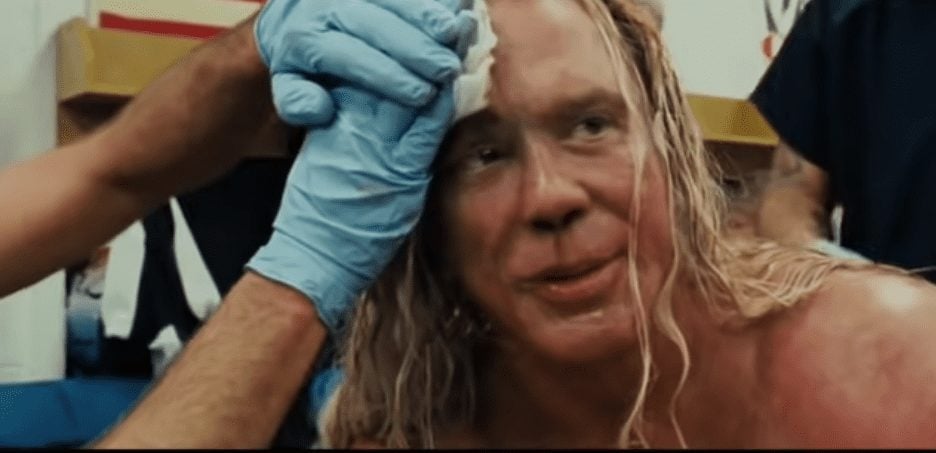
In Darren Aronofsky’s The Wrestler, Rourke gives what might be his best career screen performance in a part he was born to play. Drawing several parallels to his own life and career in the film, as Randy “The Ram” Robinson, Rourke is a glamorous 1980s star wrestler living 20 years past his prime in the present day. Living in a trailer park with unpaid bills and failing health, his heyday is long behind him. He forges on, playing in rooms a fraction of the size of the arenas he once graced. With a handheld camera following his every move, the action is set up pseudo-documentary style, with sparse realistic settings and able co-stars surrounding Rourke. In the best of these parts, Marisa Tomei (in the midst of her own comeback after her welcome appearance in Before the Devil Knows You’re Dead) plays a stripper named Cassidy who has a dedicated home life and refuses to get close to her clients, Rourke among them, even though she feels obvious affection for the bighearted ex-hero.
Director Darren Aronofsky understands how fully Rourke inhabits The Ram, and he fills his frame with Rourke’s performing abilities in nearly every shot. To say that Rourke is effortlessly watchable is an understatement. And while the original screenplay – which might mirror the real life of wrestler Terry Funk – hits some predictable notes, you are completely with Rourke on his journey. Just as we are urged to feel for Rourke himself, we root for The Ram in his attempts to hang in the game long after he should have quit. We also cringe at the multiple moments where Rourke’s character, due to the effects of bad decisions and a life of overdose, tries to desperately re-create the glory days of the 80s.
In the end, we can also hope that, unlike The Ram, Mickey Rourke is really back to stay and is able to realize the considerable potential that he has exhibited of late. If The Wrestler is any indication of that, we in the cinema audience – along with Rourke himself – should be treated to the abilities of an actor who was absent from view for far too long.
Interview with Darren Aronofsky
How complicated was the casting of The Wrestler?
Darren Aronofsky: It was always going to be Mickey. When I first met him, there was such fire in his eyes. I was inspired by that. We spent a long time researching the character and making the script better. It took a long time to make it work – a lot of research and meeting people that made the character richer. We started working on it in 2002, and we really kicked it in 2005 when Rob Segal the writer came on. That’s when things took off.
Did the subject matter inform your shooting style?
Darren Aronofsky: It was always about doing something really basic and very documentary style and very reactive to the actors. Everything was shot handheld. I really wanted Mickey Rourke to do what he does and be as free as he could be and give it that energy. I wanted to be able to follow him. That was the spirit.
Did you shoot this all on location?
Darren Aronofsky: Yes – we shot all over Jersey. He worked in Bayonne and had a trailer in Rahway. He takes his daughter to Asbury Park. We were in tons of towns.
How much of being a New Yorker informs you as a filmmaker?
Darren Aronofsky: It’s the city I love and was born in and raised in – it’s part of my DNA. I absolutely have stories to tell. I love the energy on the streets. I love it all.
Was Ram based on any real wrestler?
Darren Aronofsky: Unfortunately, I lot of these guys lives are very clichéd. You meet one, you meet a lot of them. They all have similar tragic stories. It was an amalgamation of different guys during our research trips. We spent five years researching it. We did lots of cities and towns – big events and small events, everything from big halls to veteran’s halls.
Do you have an agenda for your directing career?
Darren Aronofsky: You can’t think about the big picture – you got to keep moving forward. You got to keep pushing stuff forward.
What is your favorite part of directing?
Darren Aronofsky: Working with actors – that’s the main reason I did The Wrestler.
Freelance writer and video producer Scott Essman’s books and DVDs about special effects in Hollywood motion pictures are all available under his name at Amazon.com. Since the mid-1980s, Scott has been writing and producing projects about motion picture craftsmanship. He has published over 350 articles as a freelancer and has produced over twenty publicity projects for Universal Studios Home Entertainment where he made video documentaries and wrote publicity materials. He published his first book, “Freelance Writing for Hollywood,” for Michael Wiese in 2000.
Featured in StudentFilmmakers Magazine, January 2009 Edition.
Sign Up for your own subscription to StudentFilmmakers Magazine.
- Click here to sign up for the Print Subscription.
- Click here to sign up for the Digital Subscription.
- Click here to sign up for the Bulk Subscription for Your School or Business.