Reference: StudentFilmmakers Magazine, May 2007. Using a Polarizer to See through a Windshield: When Closer Isn’t Clearer by Ira Tiffen. Pages 6 & 7.
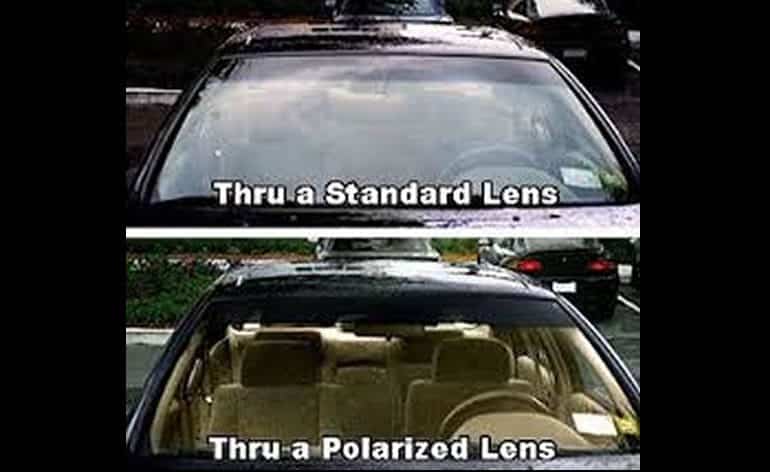
The robbers burst through the bank’s doors with a bang, racing straight for the getaway car. Sitting quietly at the curb, its idling engine belies the thunder about to emerge. The camera moves in to take a closer look at the driver and his henchman (See Image 1). We can’t see them clearly amid the reflections from the windshield. On goes the polarizer, and we see more of these villains (See Image 2). But wait! Can it be? What’s this? The driver can’t be more than five years old! If only we could see even more clearly.
The cameraman knows just what to do. Moving the camera further away, he zooms in to maintain the framing (See Image 3). Now, we can see more of the driver. He’s not a getaway driver at all! We can see, in fact, that he’s none other than my five-year-old son, Max, playing! And his ‘cohort’ turns out to be Big Blue Bear, not a villain after all!
What a surprise awaits the scrambling thieves headed their way! It’s a good thing Max knows how to keep those car doors locked! These thieves are sure to be caught.
Now let’s take a step back, literally, from our make-believe movie scenario.
What’s happening between Images 1 and 2 is about what we would expect from a polarizer. Without a filter, the reflections almost totally obscure the view through the windshield. Placing a polarizer on the camera lens reduces these when the angle of reflectance is close to the ideal of 33°. When the camera is close to the windshield, however, more light reflects at angles further from the ideal, and we still see more reflections than we want.
The solution, as our cameraman knows, is to move the camera back, away from the reflecting glass. The farther you go, the more the reflections come closer to the ideal angle; more of them can then be absorbed by the polarizer. More details become visible through the glass, as can be seen when comparing Images 2 and 3.
Our bank robbers would also have liked getting further away, but they learned this lesson too late. On the other hand, you still have plenty of time to cash out with this knowledge – that sometimes you can see more clearly by getting further away.
In over 30 years of making optical filters, Ira Tiffen created the Pro-Mist, Soft/FX, Ultra Contrast, GlimmerGlass, and others, netting him both a Technical Achievement Award from the Academy of Motion Picture Arts and Sciences and a Prime-Time Emmy Award. Elected a Fellow of the SMPTE in 2002, he is also an Associate member of the ASC, and the author of the filter section of the American Cinematographer Manual.