Shooting and Editing Aloha New York: Carolina Cruz Santiago Rides the Wave of Success (and Hard Work) to the Tribeca Film Festival by Taryn BenskyI

Reference: StudentFilmmakers Magazine, May 2007. Shooting and Editing Aloha New York: Carolina Cruz Santiago Rides the Wave of Success (and Hard Work) to the Tribeca Film Festival by Taryn BenskyI. Pages 20 – 23.

Like many of her peers, Carolina Cruz Santiago chose to focus her directorial debut on two of her greatest passions. However, unlike most of her peers’, her film was selected to premiere at the Tribeca Film Festival. Santiago’s Aloha New York is a 22-minute short film which follows three surfers over the course of a year. Shot at Rockaway Beach in New York City, the largest urban beach in the country, the film highlights a subculture that illustrates the diversity and variety that is so intrinsic to the city’s cultural and social landscape, and explores the dichotomy between the beach’s calm and the city’s chaos.

A New School University 2007 graduate, Santiago established an interest in her subject after a visit to Rockaway Beach to study the waves and surfers for a semiotics class. Including research, Aloha New York was conceived and shot over a two year period without a budget, circumstances which show Santiago’s commitment to and passion for her subject. “I knew I had to fully commit to telling a story I was personally interested in. So for me to combine two things I’m highly passionate about – surfing and storytelling – was ideal to embark on my first project,” says Santiago. “I think as filmmakers, we are drawn to tell the stories we are personally invested or interested in, to examine and question ideas you have about your subject. For me, Aloha New York was a way for me personally to resolve being a New Yorker and a surfer.”

A New York identity is as integral to the film as the act of surfing, an idea that is not forgotten by Santiago. It was very important for her to premiere the film in New York City, an opportunity which was given to her by the festival. Aloha New York’s audience is not intended only to be New York surfers. The short’s universal appeal lies within the fact that it is not merely a ‘surf movie,’ “it is a film that explores the meaning of having a passion and finding connection, even in the isolating world of New York City,” explains Santiago.

Throughout production, Santiago’s themes and intentions for the movie changed as her focus shifted, leading to a more thorough and thoughtful story. “When I initially started the film as a thesis project, I had the concept that I would follow the lives of four surfers throughout a year. I shot winter, spring, summer and fall, and the four surfers turned into many more as I met so many interesting characters. In the end, three surfers’ stories were told, and I shot over a period of a year.”

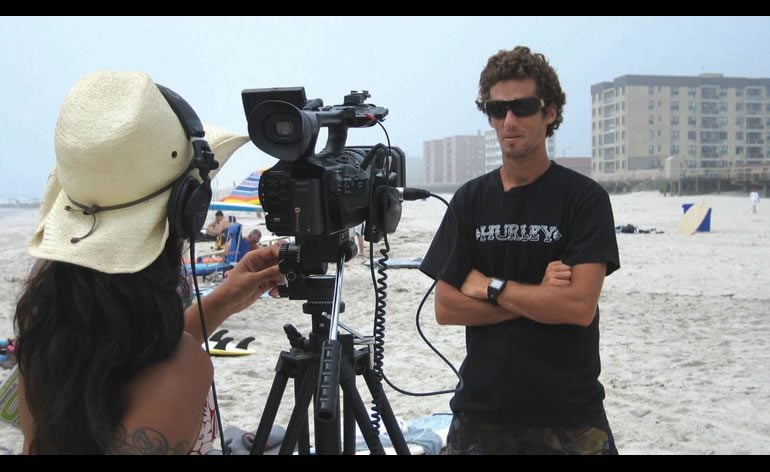
Santiago’s production team consisted of herself and a few friends from school who helped with shooting the film, holding a boom and carrying equipment. She also found herself shooting solo due to her budget, which ultimately worked with the film’s naturalism. “With the smaller equipment, it was easier for the interviewees to be themselves without having to be self-conscious,” says Santiago. They began shooting on Mini DV on the Panasonic DVX 100A and switched over to the Sony HDV Z1U to get a higher quality image. Aloha was originally shot on HDV and down-converted to SDV, using footage from both cameras. “I thought that we would have an issue with mixing the two cameras – the Panasonic DVX 100A 24P footage with the Sony HDV Z1U footage, but with the magic of post-production and the tools available to us, we were able to get a close-enough match.”

Confronted with difficulties in filming due to the weather, Santiago was forced to bend to the whim of the ocean. “When you shoot something as temporal as surf there are many challenges…If it wasn’t the drastic cold, it was the blaring heat. I decided not to shoot surfing in New York’s blizzards, of which some of the best surf is in the winter, because of the potential damage to equipment and lack of budget, but it was also not important to the ‘story’ of the film.” The ocean’s temperament also affected shooting, as surfing conditions changed drastically and constantly over the course of a day. “So, Mother Nature provided us a lot of challenges. But, the overall lesson was: patience,” says Santiago.

Film equipment required extra protection because of the weather as well, an issue that Santiago realized during filming and subsequently addressed. “The wind and moisture from the sea air were definitely a concern. I knew with the amount of time I was at the beach there would be buildup on my camera. For safety, I had my camera professionally cleaned once a year.”

One of the largest challenges of Aloha New York was editing all of Santiago’s footage down to a specific story. “There are thousands of stories to be told at Rockaway – from the history of surfing in New York City to the beach bungalow community that thrived in the 1920s, to the development that is happening out there now to the variety of characters who surf out there,” says Santiago. With the many possible storylines and accompanying footage, editing Aloha down to a final product was a “big challenge.” Producer Joseph Spaid, Associate Editor Ananda Tinio, and Santiago herself, along with Fernanda Rossi, who Santiago said is also known as the ‘Documentary Doctor,’ crafted a short film that embodied what Santiago had captured.

With Santiago’s goal of acceptance into the Tribeca Film Festival, she knew “the story had to be good and the filmmaking had to be stellar” because of the festival’s high standards and level of competition. The editing for submission to the film festival took three months to complete, with another month after receiving news of official selection to finalize everything, including sound, music, rights, graphics, and color correction. Santiago began editing on a Mac using Avid Xpress Pro, but soon explored using Final Cut Studio and, after hiring an Associate Editor, decided to edit the film with Final Cut. Santiago’s sound designer and mixer, Jim Briggs, used Pro Tools. The challenges of editing the film in time for submission to the film festival altered Santiago’s initial plans, but did not sacrifice the end result. “I initially thought we would only use HDV footage of surfing, giving the surfing scenes a ‘richer’ and more beautiful look, but with the rush to get the project completed we bypassed the HDV capturing and kept the footage in standard definition, as the images were still beautiful.” As evidenced from Santiago’s final result and acceptance into the film festival, Aloha is a success expressly because of the journey Santiago underwent throughout the editing process.

“I aimed for the Tribeca Film Festival, and literally thought, ‘What did I have to lose by submitting to the festival? And if I wanted to be a filmmaker, I better get used to rejection,’” It turns out Santiago did not need to become immediately acquainted with a negative response, as her first submitted film was picked up for the festival.
Santiago’s experience proves her success was due to her consistent passion for her subjects and a constant journey, culminating in a short film that reconsiders the notions of urban life. Her lessons from filming Aloha are just as relevant for other first-time directors, as well. “My advice for new directors is to make a film they care about first and not worry about festivals or grants or funding. Filmmakers should make films they whole-heartedly believe in without having the need for ‘validation’ from establishments. That being said, one can make films for an audience or one can make films for the sake of making films,” says Santiago. “If you’re making films for people to see, then know what it is you want them to see and why you want them to experience it. Then, understand it is an experience, and [find] the best way for the audience to ‘experience’ your story.” Ultimately, Santiago’s advice for future filmmakers is simple. “In summary, make something you’re passionate about, know your audience, set goals, and make a plan and stick to it!”

With Aloha New York, Santiago appears to have followed her own advice. “I didn’t make a film to get into festivals, I made a film because I wanted to tell a story, but I knew I wanted that story to have an audience.”
Taryn Bensky is a writer currently residing in New Jersey. She is studying Journalism & Media Studies and Art History at Rutgers University, where she will be a senior this fall. She has previously written about film in the Inside Beat, Rutgers’ weekly entertainment newspaper in The Daily Targum.

About Us

StudentFilmmakers.com is where creatives grow. Learn filmmaking, connect with industry pros, and access tools, contests, and inspiring educational resources.

Advertisers

Sign up for our Newsletter

Discover exclusive access to free webinars, hands-on workshops, and cutting-edge insights into emerging technologies and workflows. Sign up with the form above to stay ahead in the fast-evolving world of filmmaking.

×