Reference: StudentFilmmakers Magazine, August 2007. Q&A with Emmy-Nominated Cinematographer Cira Felina Bolla: Award-Winning Documentary TV Series, “Stories of The Sharp Experience: Episode 5” by Jody Michelle Solis. Pages 26 – 28.
Stories of The Sharp Experience: Episode 5 receives Emmy awards under the categories of Documentary, Direction, and Editing at the 33rd Annual Pacific Southwest Emmy Awards, held Saturday, June 16, 2007 in Carlsbad, CA. Receiving an Emmy nomination under the category of Photography, up-and-coming cinematographer Cira Felina Bolla discusses with StudentFilmmakers magazine her experience shooting the documentary. She compares it with her experience on the House M.D. set, during her mentorship under Roy H. Wagner, ASC.
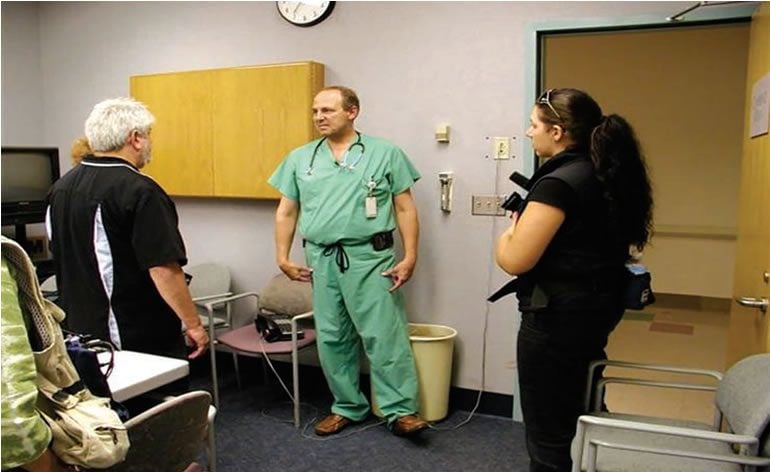
Produced on location at Sharp HealthCare hospitals and medical offices, the compelling documentary features true-life stories of advanced clinical care told in the words of patients, their families and caregivers. In Episode 5, emergency stroke experts save a stroke patient, and a heart transplant team works to save a man hours from death. Computer-navigated hip replacement surgery brings new hope to a once very physically active patient; and high-risk newborns receive intensive care from a dedicated team.
How and when did you get involved with this project?
Cira Felina Bolla: I applied for the job and met with the director, Arnie Lerner. We spoke at length about being in close personal environments, and I shared my own understanding of the necessity for being an “invisible” presence as well as voyeur.
You shot interviews with patients, their family members, and medical professionals. You also followed patients and their family to capture what they do in their daily lives. What were your thoughts about the project before you began?
Cira Felina Bolla: That anything could happen, and I would need to employ both my physical and emotional awareness of the people I was photographing. And, that I would have an opportunity to work on a purely instinctual level.
How frequently were you filming in the hospital?
Cira Felina Bolla: Fifty-percent of the shoots are generally between interviews with doctors, patients, and interwoven with an actual surgery or procedure.
What was it like filming the patients and their family?
Cira Felina Bolla: Very intimate. It’s a deeply personal experience to share with another person. Yet the object is to both experience the moment of documentation with an invisibility that requires non-judgmental humility. A paradox: to share an intimate moment and yet be completely separate from it.
Were there moments you felt uncomfortable?
Cira Felina Bolla: I do on occasion get a vibe so to speak, and I trust that part of my awareness. I adjust and/or accommodate the situation as professionally and quickly as I can in that moment.
How do you keep a professional distance?
Cira Felina Bolla: The physicality is only one level of it. A professional distance in my honest opinion has more to do with mindfulness whether you’re in a documentary situation or shooting a feature film. In certain situations, I have been three inches away from people working with the wide angle lens, and they were totally at ease. Other times I can be across the room, and it will not matter. If the subject is uncomfortable then it is obvious, but most people who participate agree to share a personal moment with us, and that’s beautiful.
You were mentored on the House M.D. television series under Roy H. Wagner, ASC, where storylines involved patients, doctor relationships, and surgery procedures. Did you find a parallel between the two – being on the House set and then working on Stories of The Sharp Experience?
Cira Felina Bolla: When I was hired by Lerner Film, I thought to myself, was this life imitating art?… Without a doubt, I smiled quietly to myself on many occasions at the similarities of the two, yet one was reality, and the other, narrative.
In what ways did you benefit, enhance your skills, and/or enhance your way of thinking during your mentorship with Mr. Wagner?
Cira Felina Bolla: It was an opportunity of a lifetime, wonderful! But in brief, and I shared this with Roy when I received news on my Emmy nomination, I had called both to share and thank him for all he taught me. He did teach me so generously and out of his love for his craft. I remember one day on House, Roy suggested to the episodes director to cover a scene handheld. I watched from a corner of the room as he was braced for a G11 with a shoulder mount soon to be given to him to operate. He looked over at me and said, watch this… I did, and I saw how he got into the motion and movement of the character. It moved me, and it captured the essence of a sequence with a young girl actor in a hospital bed who was forced into sedation. Roy moved swiftly with the energy of the scene. He looked back at me feverishly writing my notes as I did for that year on set with him, and I totally saw it. It was magic to me to see how he used camera movement to convey language of the character’s experience.
When the day came that I was hired on Stories of The Sharp Experience, I had to cover a scene with an older gentleman and his two little grand daughters. I had one chance to capture it. Arnie looked at me and said, cover it. I was handheld with them in a park. The grandfather was to play ball with his girls in a game of ‘pass the ball’… I found the pulse of the scene and got in the center of the three-person triangle and moved with person to person, moving swiftly with the energy… I felt like I had played ball with them. That is the point – to flow with the scene. Roy’s teaching stayed with me, and I was grateful to the director, Arnie Lerner, for the opportunity and his trust in me to jump in and cover it with my instincts and eye. I am grateful to Roy always for teaching me to always trust my instinct and continue to develop it.
So working with Roy H. Wagner, ASC on House M.D. did give you insights?
Cira Felina Bolla: My experience with my mentor Roy H. Wagner, ASC on House undoubtedly influenced my visual sensibilities and taught me how to work inside a hospital environment among many, many other things. The Emmy nomination for Outstanding Achievement in a Photography Program is an honor that I did not expect but only dreamed of… someday. When it was announced, I called Roy and shared my wonderful news. I thanked him for teaching me and reminded him of that day on set – he remembered clearly…
I truly love my path, it fuels my soul, and I cannot imagine being or doing anything else in this life.
This Emmy nomination is a milestone and one that I will remember fondly for all time.
What cameras and types of lighting equipment do you use to film this documentary?
Cira Felina Bolla: This episodic documentary is made for both television and the web. We shot on a PD150, 3 chip Broadcast Quality, for its unobtrusive presence and ability to handhold for sometimes the entire day. In more formal settings I often chose available light. On occasion, we used a DIVA light for interviews with doctors that allowed us more time in their office settings.
Are the cameras and lighting equipment different for the interviews in the hospital versus, for example, the exterior shots?
Cira Felina Bolla: No, the equipment is the same, PD150.
Was the lighting and camera positioning particularly different depending on who you interviewed?
Cira Felina Bolla: Yes, I always work to bring out the best in people’s natural beauty whenever and where ever we are. Visually, I am very aware of people’s bone structure and angles that are flattering. This is a very important skill for a cinematographer that is learned through observation. Most people look best at a 3 quarter angle, others straight, and some can only be photographed from a high angle. It is my experience that lower angels can be unflattering in a close-up but totally work in a medium-to-wide.
Altogether, how long did it take to film Episode 5?
Cira Felina Bolla: I shot the second half of it, approximately six days that spanned over three months, if I recall correctly…
What advice would you share with new cinematographers?
Cira Felina Bolla: Integrity, Professionalism, Faith: Faith in yourself always.