Reference: StudentFilmmakers Magazine, August 2007. Elemental Photography: Set, Camera, Shot Selection, and Lighting: Elements to Keep in Mind when Composing an Image by Saro Varjabedian. Pages 10 & 11.
As I sit in my friend’s music studio and listen to him talk to another musician I cannot help but wonder how similar the language of music is in relation to film. We are sitting around a computer with a song mixed on Pro Tools. The program looks similar to most video editing software with tracks and clips all layered onto each other on a timeline. They describe how a song consists of a drum track, and a chord progression, and then, vocals, which are structured in verses, bridges and choruses. While I did not understand all the terminology they used to break down the parts or elements of a song, I did walk away thinking that a song, much like a film, is very much defined by the sum of its parts. Each part or element compliments each other to create a whole which sounds or looks good to us. If one of these parts were missing, or not executed properly, the whole would suffer.
The same analogy holds true for the composition of an image. Think of all the elements which can comprise an image. By adding the appropriate elements, and considering how each element works in relation with each other, we can compose an image which moves the story forward in an aesthetically pleasing way. These elements can be classified under four main groups: set, camera, shot selection, and lighting.
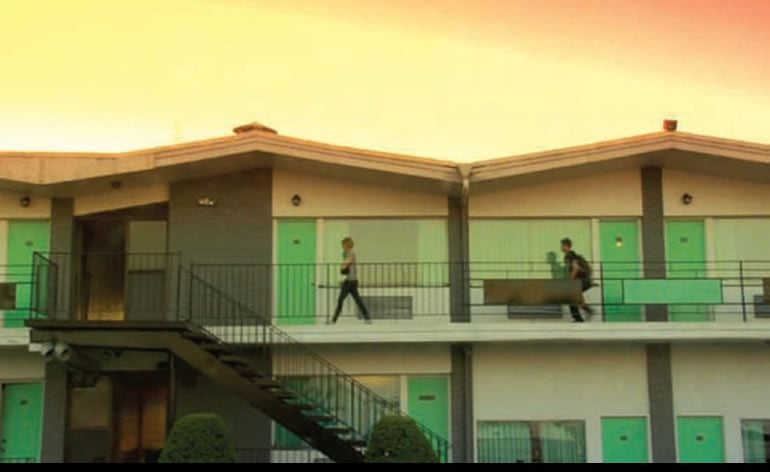
One element which can really add volumes to the image is the set or location. Consider just how much can be done within a set or with the right location to add subtext. Your set can exude a color scheme. It can define the movement and energy of the image just by the direction of the inherent horizontal or vertical lines. It can establish space and depth. And, it can convey story information like time and place. Logistically speaking, selecting the right location or building the proper set is crucial in the planning process of equipment selection, lighting set-ups, blocking and even scheduling. Often times, settling on the most available location can be detrimental to the final look of the film.
For lack of a better word, I use the term camera to encompass all the elements which are used in capturing the image. This includes formats such as DV, HDV, film, etc. When choosing to shoot in film the various types of film stock and processing methods must be taken into consideration.
Even within video, it is necessary to know the properties of the camera’s image processor. When determining what look is needed to tell the story appropriately, it is necessary to do research into such things as the latitude of a film or the color sampling of the video camera before making a final decision on the camera package.
I also consider lens selection and filters as being part of the camera category. Do you want to compress the image or flatten it with a telephoto lens? Do you want to soften the look of video with a soft FX filter?
While the main purpose of shot selection is to get the coverage needed to tell the story, what type of shots used and in which combination really determine the energy and tempo of a scene. Consider the effect of a wide shot on a character or a big close up. Which one is more intimate? What effect does a long take, which tracks in over the shoulder of a character, have? What if that same shot with a track in over the shoulder was done handheld? How intimate and subjective does that shot now become? What energy does handheld bring to the film, and when is it appropriate? While there are no right or wrong answers to these questions, these are questions that need to be asked prior to creating the shot selection. It is often tempting to try to come up with the coolest angle or a plethora of close-ups for cut-aways. But, if the shot selection is not doing anything to help convey the psychology of the story and move it forward, then more often than not, a cool shot can be jarring for the audience and actually bring them out of the film. And, when considering the sequence which the shot selection will be edited, there are those basic rules taught in school such as the 180 and the 30 degree rules which must be understood.
Lighting as an element conveys mood by making it look hard or soft, natural or abstract. Lighting can also define the time of day or season. Maybe more importantly it is crucial in transforming a two dimensional image into what we perceive to be a three dimensional image. As part of an image’s composition, knowing what light fixtures (such as a Fresnel, Xenon or Kino) produce what type of light outputs and properties is crucial in planning the look of the lighting. Take a Kino for example; it puts out a light whose property is a wide spread beam with less fall off. If that is the lighting fixture you choose to go with, under what circumstances would that work best? If you wanted to control it and make it more directional, you would probably use an egg crate. In addition, utilizing gels, diffusion or flags can add those extra touches to the light providing the ability to mold it to a specific purpose. And, if you are out on location, what does an overcast day say in comparison to say the magic hour?
But, how does one know what combination of elements will work best in composing the final image? I often wonder how a musician knows what sound they are trying to create. I imagine that one day they wake up with a melody or a tune stuck in their head which compels and guides them into creating the final song. In my experience I have found that the composition of an image works in a similar fashion. Once you have read the script and envisioned the look and feel of the film, you have at the very least some sort of guide. With some trials and tribulations, each element can be locked into place and layered on top of each other to compose a brilliant image.
Saro Varjabedian is a director of photography based in New York and has worked on over twenty films, music videos and corporate videos for various production companies. He has recently finished production on La Chambre de Motel, which he wrote and directed. Currently, he is in pre-production on the spec for GeoCache and the feature film, Testosterone.