
Shooting Solstice in New Orleans: A Drama Set in the Bayous of Louisiana with Supernatural Elements by M. David Mullen, ASC

Reference: StudentFilmmakers Magazine, May 2007. Shooting Solstice in New Orleans: A Drama Set in the Bayous of Louisiana with Supernatural Elements by M. David Mullen, ASC. Pages 10 – 14, 16.

Often I get asked “how do you find work?” and usually the answer is that most of my work comes from contacts formed on my previous jobs shooting feature films. The added advantage of this situation is getting to work with people that know and trust me, and trust is essential for a cinematographer to be allowed to explore his art fully. Without trust, a cinematographer is forced to build it gradually by delivering good (but somewhat conservative) images in tried and true ways – in other words, the cinematographer feels compelled to play it safe, only do what he knows works. You need trust in order to take chances, to be allowed to occasionally fail.

In the Spring of 2006, I was introduced by my agent to a producer that I hadn’t worked with before, Adam Del Deo, and along with him on this project, a director named Dan Myrick. The script was titled Solstice, a drama set in the bayous of Louisiana among some vacationing teens, with supernatural elements. The lead character, Megan, is dealing emotionally with the suicide of her twin sister, Sophie, at the previous Christmas, and mysterious happenings at their summer house lead her to believe the ghost of her dead sister may be trying to contact her.

At the meeting I was impressed by Dan Myrick’s intelligence and sense of humor. Dan was already famous for being one of the creators of The Blair Witch Project, and he had very specific ideas for how the horror elements of this story were to be presented. He was determined to avoid or minimize any clichés of the genre – he didn’t want the summer house to be old and creepy, he didn’t want the ghost to be some pale, decomposing dead girl a la The Ring. However, he did want a certain naturalism regarding the setting to be captured, a realistic approach to the lighting, and as much use of natural light as possible. Now it’s always a bit dangerous to go against expectations when doing a supernatural tale because to some extent, the gothic elements are part of the charm of the genre (plus they are fun for the cinematographer!). But I liked the challenge of capturing the natural qualities of the swamp location and thought that perhaps this would be a chance to do a horror film in the subtle style of a Terrence Malick movie.

The budget was what could be called the low-end of the union contract scale, and the schedule was incredibly tight, only 25 days. This sent up a warning flag for me because I’ve shot many 25-day features over the years, and have a good sense of how long things take. The problem of a short schedule on this film was that over half the scenes take place at night, many inside the swamps and woods, and night photography never goes fast. The other issue was that we had a certain number of physical effects and some plate photography for post visual effects to set up. I was also concerned that a fast-paced shoot would not allow the sort of Malick-style naturalism to creep in because of the time it took to travel to scenic spots at the right time of day.

The movie was going to be shot in the New Orleans region, despite the fact that Hurricane Katrina happened only seven months earlier. This was not only due to the evocative locations that Louisiana provides, but the new tax breaks and incentives that the state provides productions. I had just returned from the Baton Rouge area only a month before I was hired on Solstice; I had been scouting for another indie feature that ultimately lost its financing and sent me home after two weeks. While I was there, I had interviewed a number of potential local crew people, which I thought would come in handy now that I was returning just a month later.

When I was there before in late January, we were the only production starting up in that area – but now that I was returning in March to start preproduction all over again on a new project, I discovered that three other features were starting around the same time (in fact, one of them called me during prep asking if I wanted to come down to Louisiana to shoot their feature). Worst of all, one was the Tony Scott movie Déjà Vu starring Denzel Washington, a big-budget project that sucked up all the top local crew people, including almost everyone I had interviewed just a month earlier. Because of the tax breaks, there was pressure to hire as many locals as possible, but as our prep went on and the first day of shooting loomed closer, we had to start calling people in Los Angeles that we knew because we had run out of local options. Ultimately almost no one on my camera crew was local, despite our attempts. Even our Key Grip and Gaffer came from Los Angeles, along with some of the electricians and grips. Same was true in many of the other departments as well, ultimately costing the production more money than they had planned on spending. This was complicated by the fact of a housing shortage in the area because of the many Katrina refugees still living in the remaining local hotels.

Since the budget of this movie permitted us to shoot in 35mm, I wasn’t tempted to bring up the possibility of shooting in HD; I felt that the beauty of these locations would best be captured on film. But on most of my recent features, I had opted to shoot the movie for release in 35mm 2.35 “scope” prints. I like that widescreen presentation format for many reasons. One is that it allows the location to play a larger part of the frame, to maintain a sense of place even in tighter shots. Two, it makes a low-budget movie feel larger in budget. And I like the compositional challenges of the very wide frame. But on my HD features, it had been as simple as framing for cropping 16×9 to 2.35 in the viewfinder; we just recorded the HD master to a 35mm anamorphic internegative by cropping and squeezing the image in the Arrilaser. For my 35mm features, I had shot them so far using anamorphic lenses, which I feel yield the highest possible image quality for theatrical projection because of the size of the negative area reserved for the scope image. However, on this project, I was hesitant to suggest anamorphic photography because we had such small locations and we had so much night exterior work. Anamorphic has less depth of field on average than spherical 35mm photography, which is why generally you try to light scenes to at least an f/4 – however, more often than not, large night exteriors are lit to f/2, maybe f/2.8 at the most. This creates a focus-pulling challenge, not to mention that so much of the frame is in soft-focus at wide apertures that we may lose a sense of the space at night. So I suggested that we shoot in Super-35 to achieve 2.35. I also suggested we use 3-perf instead of 4-perf and do a digital intermediate to convert the 3-perf spherical photography to 4-perf 35mm anamorphic. The 25% cost savings from switching to 3-perf would help offset some of the costs of doing a digital intermediate.

The other reason why I suggested doing a digital intermediate was there was no time for complicated tests on location to determine a unique look for the movie. Dan had expressed to me the idea that gradually throughout the film, the look would get less saturated and less warm. I had experimented with photochemical desaturation on a number of my features, notably Northfork, and I knew that a gradual desaturation effect was only practical if done digitally. And even though the overall look of the movie was to be naturalistic, I knew that certain supernatural moments would shift into an Expressionistic style, and I needed some post options to manipulate those scenes.

As usual, I was given a good deal on a camera package from Panavision, who has supplied the cameras on most of my features since film school. We had a 3-perf Millenium-XL as our “A” camera and a cheaper GII as a “B” camera. The Millenium-XL is a rather expensive camera actually, but it is the most flexible to convert to Steadicam use; plus, it is the lightest Panaflex made, and since we hired a great Steadicam operator (Chris Squires), I wanted to make sure he was comfortable with the camera he would be carrying. Our lenses were Panavision Primos, which are very sharp at wide apertures. Having just shot The Astronaut Farmer using the new Fuji Eterna 500T color negative, I decided to use it again for this movie. But since we had so much day exterior and interior work too, I decided to also use the new Fuji Eterna 250D as well, which hadn’t been available for my previous movie. Since the new Eterna stocks had half the graininess of the previous generation, the new 250D stock was about as grainy as the older Fuji 100 ASA film, which meant that it was fine-grained enough for day exterior work. The Eterna stocks are also rather low in contrast, making them ideal for scanning work and post manipulation. If I hadn’t been doing a digital intermediate where I could add as much contrast as I needed, I would have looked into printing the Eterna stocks on a higher-contrast print stock to compensate.

Since the 35mm 3-perf negative is roughly 16×9 in full aperture, I decided to use a ground glass where the 2.35 extraction framelines are near the top of the negative frame rather than in the center. This allows any TV version to share the same headroom as the theatrical scope version. It also means that the boom operator doesn’t have a huge difference between the top of the TV and theatrical framelines to deal with.

Right at the start of shooting, we did 50 set-ups in a 12-hour day. Which always impresses everyone… but personally, it’s always a bad sign to me when you have to shoot that many set-ups per day just to cover what is on the call sheet. Because I know that it won’t be possible to maintain that kind of pace. Our schedule favored day exteriors first, gradually falling into night photography. In order to both work fast, and to keep a natural look, I decided to not complicate day exterior shooting. When possible, I just had a handheld bounce card on standby to augment the daylight rather than automatically reach for HMI’s or huge frames of diffusion. Of course, this means that we have some mismatches due to cloud cover to fix in post, plus some time of day mismatching, but the advantage of this style is that I can quickly grab any interesting accidents of light that happen during the day.

We had a number of days where we shot past magic hour, trying to get every shot we needed. One flashback scene in particular was shot too late in the day, requiring that I work wide-open on the lenses and push the 500T film stock, but I justified the softer, grainier look that resulted as being part of the flashback style. Occasionally, when I’m not running the second camera on a scene, I’ll send my B-camera operator, Theo Pingarelli, to grab some much-needed shots of the swamp location.

As I said, we’ve generally avoided any horror clichés in terms of style, but we had one scene where our lead character, Megan, explores an old farmhouse in the swamps, mainly shot with a roving Steadicam. I wanted it to look a little cold and monochromatic so I switched to the 500T stock with no daylight correction filters; this also allowed me to use a lot of available light mixed in with only a few HMI’s and Kinoflos. I had the colorist pull half the blueness out of the dailies, giving the scenes a steely blue-grey look. I also smoked the interiors, which helped reduce the saturation further.

Because I’m shooting fairly fast stock for daytime exterior work, rating the 250D at 160 ASA, even with ND’s and Polas, I sometimes end up shooting a scene at f/8 when the sun is out. I suppose I should be one of those DP’s who keep the same f-stop all day long just to be visually consistent, like at f/2.8 (if I know that’s what I’ll be at by the end of the day), but the truth is that I prefer shooting 35mm at the middle f-stops because it helps the focus-puller work faster – they aren’t dealing with shallow focus all day long. Every time the AC opens up the f-stop all the way to check focus by eye, I think, “boy, that looks pretty”, but in reality, actors and cameras move… and a swimmy, shallow focus look can be distracting on the big screen.

The major disadvantage of shooting 3-perf came up in the middle of the shoot: the lack of ability to strike a 3-perf contact print and project the results on location. There is an expensive portable projector made by Arri with a 3-perf capability, but that is beyond our budget. I am reliant on the lab and the editor in Los Angeles to look at any problems on the big screen when necessary, which is what happened when two wide shots in our movie, shot on different cameras, different lenses, and different film stocks, both came up soft in dailies. Panavision came out to check our lenses and flange depth but found no problems. It was clear to me that for some reason, the film was not lying flat in the telecine gate nor the projector gate. I posed the question on the Cinematographer Mailing List (CML), and one person in the U.K. suggested the possibility that the lab had over-dried the negative and it had curled, and this could be fixed by rewashing and redrying the negative. So I decided to put off dealing with the problem until post. Jump six months later when we are doing the D.I. and when these two shots come up, they are perfectly sharp! I think simply being in the vault for that period curled up in rolls on cores flattened them out.

For many day scenes early in the picture, I wanted a warm bias to the image. Rather than deal with the extra glass of pale warming filters on the camera lens, I opted to shoot my grey scales at the head of the day with a pale blue filter on the camera (the 82A or 82B) which I then took off for the scene. By timing the blue-filtered grey scale back to neutral, the colorist made the scenes that follow look very warm in dailies.

A lot of the night scenes are set in “moonlight”, which for me was a half-blue color on tungsten-balanced 500T stock (meaning halfway between 3200K tungsten and 5500K daylight). This meant using ½ CTO (Color Temperature Orange) gel on HMI’s and daylight Kinos for the most part, or ½ CTB (Blue) on a tungsten lamp. The director wanted something different from the commonly used big blue backlight approach to night photography, so for some scenes I used a helium lighting balloon contain a mix of HMI and tungsten globes to get that half-blue color; it created a soft top-light look. Other times I had to go for the backlit look, partially because some scenes had rain in them, and rain needs to be backlit to be seen. In general, I underexposed moonlit scenes by two stops, which felt about right in terms of darkness. But considering I rated the 500 ASA stock at 320 ASA (2/3’s of a stop overexposed) it actually meant that a 2-stop underexposure was really on a 1 and 1/3-stop underexposure, which gave me more flexibility in color-correcting later.

One of our most challenging scenes involved six people standing in a circle in nearly chest-high water in the lagoon in a swamp, at night. I pondered over this scene over many times in my mind as to how I was going to light for 360 degrees at night. The area had to be netted off to keep the alligators away, and then a platform had to be sunk underwater into the mud to give the actors a level platform to stand on. I had the art department use string lights (a string of 40w clear bulbs) on a nearby fishing dock to provide a tungsten-source from one angle, which I augmented with two 2K tungsten open-faced “blonds” on a high wooden post, pointing towards the action as if they were the worklights of the dock. I had to rate the Eterna 500T at 640 ASA and push it a stop, which is how I shot the carnival scene in The Astronaut Farmer, which had similar strings of clear bulbs. They seem to look the best at T/2.8 at 640 ASA in that they actually looked bright enough to light something.

With the golden backlight from the tungsten lighting on the dock, hitting some low-level smoke creeping across the water, it sort of looked like that shot in Apocalypse Now when Willard rises out of the water. Across the lake on the opposite bank, I had an 18K HMI on a condor to provide a cold moonlight source. It was at a 90 degree angle to the dock lighting. So as I worked my way around the circle in coverage, the two people standing with their backs to the dock were backlit by tungsten / sidelit by moonlight; some were sidelit by tungsten and backlit by moonlight (or filled-in by moonlight if standing on the opposite side of the circle), and the last two were frontlit by the tungsten mainly, which was a little boring… but logical since they were facing the only strong source of light in the scene.

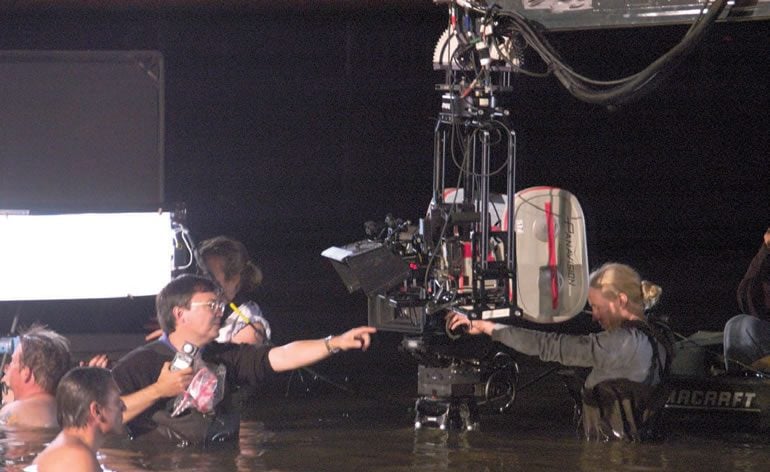
On the closer shots where the two actors were backlit by the dock lighting, I flagged off the 18K and used a 4-bank Kino for a softer blue moonlight, underexposed compared to the dock lights — which sounds simple in theory… but a nightmare to rig in four feet of water on the edge of a too-small wooden platform. This was the point where I got soaked trying to adjust the lights while wearing hipwaders. The Kinoflo in the water had a ground fault circuit interrupter. Just to get it to be two-stops underexposed when shooting at T/2.8 at 640 ASA, I ended up with two layers of 216 (plus the 1/2 CTO correction for the daylight tubes) and only one tube was switched on.

As you can imagine, everything went slower once I started putting the camera and a light plus flags into the water. It was a nightmare; I can understand why water movies go over-schedule! For the wide shots, we shot from the shore. I managed to get the production to rent a 30’ Technocrane, which we used to good effect to get high and low angles.

But once we went in for closer shots, the cameras had to be mounted to tripods in the water, with the lens and camera body just above the waterline.

At the same location by the lake, we shot a campfire scene. For the wide shot, I buried two orange-gelled 4’ Kino tubes in the ground between the actors and the fire, which gave me just under a T/2.8 on their faces from the mix of real firelight plus the soft orange Kinos. For the close-ups where there was no fire at all in the frame (too crackly for sound) I switched to using two 1K’s on a double-headed low stand, gelled orange, and going through a 4’x4’ frame of 216. One was on a flicker box and the other on a dimmer, blended by the diffusion frame to create a believable flicker effect.

Our worst day happened when we finally made the move from the lake house location (where we had been for a week and a half) to a nature preserve with a swamp and an abandoned brick house which played a key role in the mystery.

Well, that company move went as badly as I’ve ever seen in a while because of heavy rain the night before. The drivers got some of the production vehicles stuck in mud at the lake house… and then got other vehicles at the new location also stuck in mud, including a condor needed for the night photography. This condor also now blocked any access by other vehicles into the location. Trying to salvage some of the day, I thought maybe I could shooting something in what natural light was remaining if we hand-carried our camera gear down the road, around the condor, to the shooting site. But once we managed to do that, I found out that during all of this confusion, the drivers had forgotten to pick up the actors from the hotel. So even though I could have gotten a shot off by 4:30PM, it wasn’t until 7PM, with just a half-hour of weak light remaining that I got an actor to shoot. And again, I was rushing to get the scene, shooting handheld with no marks, no rehearsals, with the lens aperture wide-open.

Our last night at the nature preserve consisted of rain scenes, and the only water truck we could get was underpowered; unable to get decent water pressure, we spent a lot of time moving rain towers around to get them as close to the edge of frame on every set-up. And then equipment started breaking down in every department before we could roll. I had a 4K HMI shut-off twice (with a ten-minute restart time needed each time), then the remote focus on the Steadicam broke down, then the sound equipment stopped working… and during all of this I could hear the producers saying, “but we’ve got to shoot!” Luckily, we managed to light our last big scene quickly by floating a lighting balloon overhead, and then we faked all the coverage against the same set of (out-of-focus) trees, with the same backlight from the condor. The last shot was a simple stunt – the actor had to leap over a fallen tree and then pretend to get his foot caught in an animal trap. But dawn had arrived and was filling in the shadows with soft, deep blue light. I pulled all the 1/2 CTO gel off of the HMI’s to get a full blue color for the moonlight, then I put an 81EF warming filter in the cameras to correct the color back to half-blue. It actually had a nice look for the woods, the blue dawn twilight acting as my fill and the HMI as a big backlight, plus rain and smoke through the shot.

I’ve never had to deal with as many bugs in the air as at night in a swamp. Climbing up to change a scrim in a light involved swallowing a lot of hovering insects — it was horrible. And actors had to put up with flying beetles covering our overhead helium lighting balloon, only to then occasionally rain down on them.

We got to spend a few nights after that shooting in the Garden District of New Orleans, a pleasant change. Our lead actress (Elizabeth Harnois) had flashback scenes with her character playing opposite her identical twin, so we had to deal with shooting parts of scenes and then waiting for her to be changed to the other character, with a wig, new wardrobe, etc. And we had to shoot one scene outdoors at night with a greenscreen so we could have her walk past herself as the twin. This was all very time-consuming.

Our 25-day schedule had one major flaw in it – it was too short! We needed about nine days at the lake house and three days on stage to finish the movie, but this plus the other location days brought the total schedule to 26 days. So the “solution” was to drop one of our days at the stage at the end of the shoot and combine three days of work into two. Unfortunately, it is the nature of any shoot to fall a little behind and owe shots from previous scenes. So on Day 25, the last day, our call sheet had 17 scenes listed, five different sets, nearly nine pages of script, interiors and exteriors, and two scenes involving stunts and visual effects! We worked 20 hours on our last day, from 7:30PM to 3:30PM on the following night, which ultimately gave me two hours after wrap to go back to my hotel, shower and pack, and get on my return flight home to Los Angeles –so I missed an entire night of sleep. The truth is that we worked a 26th day after all.

At some point on this horrendously long day, I got asked if I could light the scenes badly (or less well) in order to work faster, but I personally feel that it takes just as long to light a scene badly… so that wasn’t going to help anyway. One problem was that we were now shooting day scenes on a soundstage. There was no such thing as available light coming through the windows of the sets. Everything had to be lit to create a believable daylight look. I couldn’t just turn on a Kinoflo to augment some natural light and shoot quickly. So we plugged ahead, scene after scene, until we were done.

A few months later we spent an additional three days on a stage in Los Angeles shooting more material to cover scenes (suspense sequences tend to need a lot more shots and cuts), and a few new scenes were added. Soon after editing was completed, the digital intermediate work was done at Technicolor TDI in Burbank. The negative was scanned on a Spirit 2K and color-corrected on a DaVinci while being digitally projected on a big screen. A number of early scenes in the movie became more flashback material, so I decided to give these shots a unique look by adding some digital diffusion (sort of an overlaid Gaussian blur), plus crushing the blacks to give it a somewhat glowing but high-contrast look. Otherwise, we kept with the natural look originally planned, with a mild amount of desaturation as the story moved into the moonlight scenes near the climax. Unfortunately, we had to resort to using some HD stock footage to cover a driving montage, footage that I had been looking forward to shooting myself in Louisiana.
Throughout the production, no matter how badly things were going, director Dan Myrick never lost his sense of humor and was never rude to people, which I greatly appreciated. Producer Adam Del Deo was also a very generous and pleasant person. All of this helped make the experience highly enjoyable despite the difficulties. I look forward to returning to Louisiana someday with enough time to really explore the landscape and capture its unique beauty on film.

M. David Mullen, ASC has earned two Independent Spirit Award nominations for best cinematography, for Twin Falls Idaho in 1999 and for Northfork in 2003, and has photographed over thirty films, including The Astronaut Farmer (2007), Solstice (2006) Akeelah and the Bee (2006), and Shadowboxer (2005).

About Us

StudentFilmmakers.com is where creatives grow. Learn filmmaking, connect with industry pros, and access tools, contests, and inspiring educational resources.

Advertisers

Sign up for our Newsletter

Discover exclusive access to free webinars, hands-on workshops, and cutting-edge insights into emerging technologies and workflows. Sign up with the form above to stay ahead in the fast-evolving world of filmmaking.

Scroll to Top
×