Molding Your Character with Bondo Makeup
by Todd Debreceni
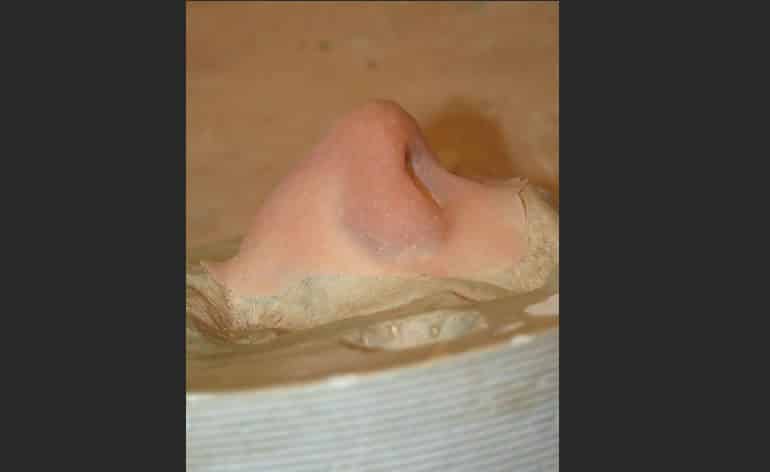
A rather easy-to-use makeup effect that has dramatically good results and looks great on camera is 3D prosthetic transfers. These bondo transfers, or Pros-Aide transfers are becoming more and more widely used worldwide for a variety of applications by great makeup effects guys like Matthew Mungle, Vittorio Sodano, Christien Tinsley, Kevin Kirkpatrick, Antony McMullen, and even me. They even won Christien Tinsley a 2007 Scientific and Technical Academy Award for his development of this process.
These transfers are not only easy to use, but they’re also pretty easy to make – once the particular appliance has been sculpted and a flat negative silicone mold has been made – and kept on hand in enough quantity to last for an entire shoot, or just to have as a quick out-of-kit application possibility. They really are nothing more than Pros-Aide water-based acrylic adhesive that has been thickened, frozen, thawed and dried. That’s the really simple explanation.
As with almost every process in makeup effects, the Pros-Aide can be thickened in more than one way; one way, the way I was taught, is to mix Cab-O-Sil – fumed silica – into the adhesive until it reaches a consistency you find usable – not runny, but not overly thick. Another way is to forego the Cab-O-Sil and just use Pros-Aide and mix it in a mixer on its lowest speed for 8 or 9 hours until it’s thick. If you whip it, you’ll create air bubbles, which you want to avoid; you just want to stir the Pros-Aide. Allowing the Pros-Aide to mix this way allows the water to evaporate without solidifying the adhesive; and you’ll wind up with a softer appliance than if you add Cab-O-Sil as a thickener. As an additional softener, you can add from 5% – 16% DBP (Dibutyl Phthalate) Plasticizer to the Pros-Aide. You can color the Pros-Aide with flocking, or with a bit of pigment – food coloring, powder, etc. Do some experimenting on your own.
This industry thrives on innovation and experimentation.
In addition to a silicone mold of your appliance, you’ll also need temporary tattoo transfer paper – available from several sources, including Alcone, Motion Picture F/X and Nigel’s Beauty Emporium, and silicone parchment paper, which you can get from most any baking supply company.
Steps to make a prosthetic
- Put some of the bondo into your silicone mold and squeegee off any excess, making sure not to create air pockets in the mold.
- Place a piece of silicone parchment over the bond and squeegee again to remove surface air bubbles.
- Put the mold into the freezer – no longer than an hour and a half – until frozen, then remove the mold.
- Carefully remove the frozen appliance from the silicone mold and allow to thaw and dry; a great way to dry out the transfers is with a fruit dehydrator.
- Once the appliance is thawed and dry, it can be placed onto the tattoo transfer paper; apply a thin layer of Pros-Aide to the appliance out to the edge of the bondo. One nice thing (of many) about Pros-Aide is that is goes on white but dries clear. When the adhesive is dry, press it face down onto the shiny side of the transfer paper, and then carefully peel off the silicone parchment. If the edges of the appliance start to come up, press them back down until they stick.
- Now you’re ready to apply the transfer. Wet the back of the paper with a moist paper towel and hold it in place for about 30 seconds.
- Peel off the transfer paper, and smooth the transfer with a bit of water, and let it dry. If there are any visible edges, they can be blended off with a small brush and 99% isopropyl alcohol.
- Seal it with Pros-Aide (let it dry first) and then powder, and seal with Ben Nye Final Seal or Reel Creations Blue Aqua Sealer.
These prosthetics look terrific on stage and on screen, even in HD. Once they’ve been applied and sealed, you can even wear them swimming. When you’re done, they can be removed with just about any makeup or prosthetic adhesive remover. For the most part, these transfers are for one-time use only. Good luck, and have fun! Send me pictures!
Todd Debreceni began his career in entertainment with PBS while in graduate school at the University of Tennessee, and has worked at TBS in Atlanta, and 20th Century-Fox Television, Warner Bros., and Walt Disney Pictures in California. Todd has created makeup effects for many theatre productions, and is a recipient of a 2006 Denver Post Ovation Award for makeup. In addition to working in his Aurora studio, Todd conducts workshops and teaches at several Denver-area schools.
For more sign up for Student Filmmakers Magazine!