Reference: StudentFilmmakers Magazine, Working with the Sun for Various Outdoor Shoots: Ways to Make the Sun an Ally Rather Than an Enemy by Carl Filoreto.
Control. It’s the reason producers and DP’s like to scurry inside to a well-appointed hotel suite when they face capturing an important interview for video posterity. Need to shoot a vital on camera segment with the host of an hour long documentary? Well, the first instinct is to look for a nice, cozy indoor location. Why? Simple. It’s easier to control the many elements that can adversely affect the shoot. Factors like harsh lighting, extraneous noise and foot traffic.
The art and science of video production though, often means going outside and working in the natural environment. This scenario is fraught with risks and danger and can throw a shudder through even the most seasoned camera practitioner. Moving outside literally opens the door to a variety of factors that the video crew now must handle with dignity and grace, but most importantly, without any loss of quality. The two primary culprits are the sun and noise. Urban settings come replete with a staggering assortment of unwanted and uncontrollable sounds like traffic, horns, sirens, construction noise and loud voices rising above the general chaos. I’ve even encountered bizarre noise problems in pristine natural settings located far from the concrete jungle. Let’s focus for now on how we can come to terms with handling the sun for various on camera outdoor shoots.
Fortunately, there are ways to make the sun an ally rather than an enemy. And if you’re working with a limited, or in some cases a lack of, a budget, then you’ll be delighted to know there are some low cost solutions available. Now my primary rule when handling outdoor interviews and on camera segments is to make sure the person on camera is always facing away from the sun. During many years in the business, I’ve yet to find anyone who enjoyed looking directly into that fiery orb in the sky. It’s unpleasant, it makes people squint and it induces lots of sweat. And if you’re not shooting during the “magic hour” period when the sun is low on the horizon, it can cause the dreaded black hole look. This condition occurs when shadows are created under the brow line as a result of a high sun angle, thus bright vibrant eyes are transformed into dark empty shadows. These results are not good for the production, or your career.
Of course, the simplest solution is to put the subject in the shade, and proceed from there. Unfortunately, things are usually more complex. So if you can’t get the subject out of the sun, situate the subject so that his or her back is to the sun. This simple maneuver accomplishes two very important things. One, it creates an instant natural backlight, and that’s always a positive step. Second, the background has a good probability of also being shaded. If you think about it conceptually, and contemplate the angles involved, you’ll see that for the same reason that the subject’s face is in the shade, the background will be in the shade. This makes it much easier to control exposure, and prevent any problematic hot spots in the background.
Sometimes, though, you’re going to have overexposed areas in the background, and you have to somehow get more light on your subject in order to equalize your exposure. Reflectors are an elegant solution. They’re usually oval or round, light, have a handle so you can carry them around, and come in a variety of colors, textures and finishes. They’re small enough that a producer or handy production assistant can hold them in place, and quite cleverly most are made with a different colored surface on each side.
Optimally, I’ll use a white-sided reflector since it creates the most natural look. Hopefully, the light generated by the sun will be intense enough that a white reflector will bounce back sufficient amounts of light to fill in any facial shadows. In reality, I’ve found that’s rarely the case, so I’ve grown fond of reflectors that are often billed as being a “sunlight” color. When you look at these closely, they have a weave of gold, silver and reddish-hued threads that in combination often offer a decent match to the ambient outdoor color temperature. Lots of folks like to use a gold or silver reflector. Keep in mind, a gold or silver reflector is going to reflect, well, a gold or silver hue. Too much of a good thing can result in an unnatural look. So when using these colors, try to check skin tone in a monitor, or use a discerning eye, and make sure you’re not creating an uncomfortable metallic glow.
Several years ago, I was hired by a political action group to shoot a ten-minute video highlighting one of the burning issues of the day. A principal interview location was a large park located in the middle of downtown Denver. The state Capitol was located on one end of the park. The iconic City and County Building of Denver was situated on the opposite side. And, the Denver skyline peered over the trees in another direction. These are all fabulous backgrounds for politically focused interviews. During a site survey, the prospect of shooting in this seemingly wonderful location was shattered by one critical detail: there wasn’t any power available. None. To muddy the waters a bit more, two of the interviews were scheduled as two camera interviews. And to ratchet up the degree of difficulty, the first interview was scheduled to begin at 11:30 in the morning.
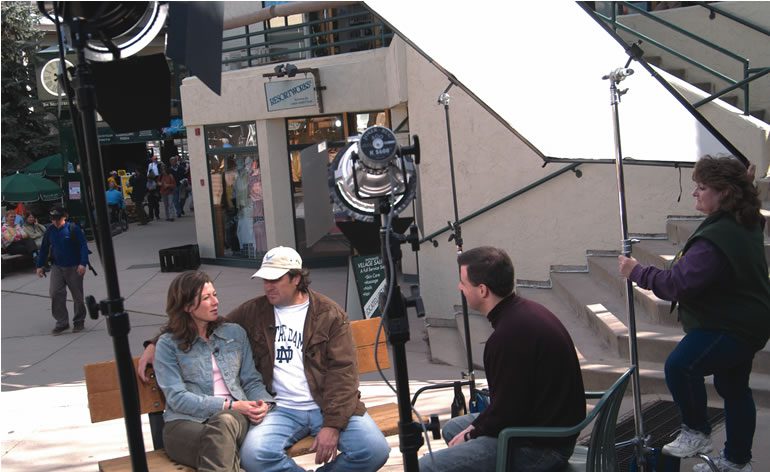
Lighting two people sitting opposite each other in the great outdoors when the sun is directly overhead is a serious production problem. In this case though, one of the most versatile outdoor lighting controls, a collapsible modular product made by Westcott called a scrim jim, came to the rescue. It consists of aluminum tubes which attach together to create frames that are 4’x4’ or 4’x6’ or 6”x6” in size. The tubes have Velcro attached to one side enabling you to mount a dizzying array of scrims, silks and nets. On this particular day we deployed a variety of 6×6 frames using sunlight reflectors and china silks to bounce light into and remove light from the participants in the interview. When we finished, we were all pleasantly surprised at the quality look of the interviews. It almost appeared to look like we were lighting the set with a bank of HMI’s attached to a generator truck.
In this configuration, I’m partial to china silks, which are made from a white fabric that cuts down on the intensity of the sun, and gently diffuses the light that does penetrate it. I often use a 4×4 china silk to remove the harsh shadows created by the sun, and then fire up an HMI and direct it into the locations that need to be “punched”. In the scenario I depicted earlier, I’ll use it to cut down on the amount of sunlight hitting the back of a subject’s head, and mold a pleasing backlight with it.
Now suppose you eye up your shot, and everything is fantastic, but you notice the background is brighter than your subject. Black nets are a simple way to cut down on the amount of light generated in your background. Position the net far enough behind the subject so that the lens can’t see it, and voila, the background is muted. Both china silks and black nets can be purchased or rented according to f-stops. A two stop black net will, you guessed it, cut down the amount of background light by two stops.
So what happens when you’re in a national park, it’s raining, the looming ponderosa pines are cutting down what little light is available, and your interview subject looks alarmingly dark? If you can arrange the interview to happen near a road, and your car is handy, then you can use a great device called an inverter to provide instant power, and thus light, to the scene. By attaching to your car’s battery, inverters convert the direct current produced by your vehicle, and magically change it to the lovely alternating current we’re used to using every day.
Inverters come in a range of outputs, and I’ve gravitated to the 800 watt variety. It provides enough power to comfortably use a 400 watt HMI, and on a good day, it’ll fire up a 200 watt HMI as well. I used to haul around a 1650 watt inverter, but it was bulky and heavy; and I found that most car alternators simply wouldn’t generate that amount of power anyway. The 800 watt versions can be purchased in the tool section of most home improvement stores for under a hundred bucks.
I’ll provide you with a cautionary tale that’ll encourage you to purchase a spare as well. Several years ago, I was dispatched to Montana by NBC News to do an interview with a forest ranger about bear attacks in the area. It couldn’t be more simple, just an interview and several minutes of b-roll with the ranger. When I arrived at the meet point outside Missoula it was raining, it was dark, and we were setting up in a park campground. I was unphased by the conditions until I wired up my trusty 1650 watt inverter, and proceeded to watch it disintegrate under a flurry of sparks. Well the clock was ticking, and it set off a mad scramble to find a power outlet, which we miraculously located nearby. So here’s an example of a simple shoot that easily could have had a disastrous result. I learned my lesson and now carry a spare. And I even use a small 30 watt inverter with an attachment that allows me to plug it into the power receptacle in my car so I can power a battery charger, cell phones or my laptop.
Carl Filoreto is an award-winning DP, and his company is Elk Run Productions, Inc. (www.elkruntv.com), which has a roster of clients that spans corporations, production houses, crewing agencies, and broadcast and cable networks, including Dateline NBC, The Food Network, and The Travel Channel. Prior to starting his business, Carl won seven regional Emmy awards, numerous national and regional National Press Photographers awards, and multiple awards from Colorado Ski Country and the National Snowsports Journalists Association, while working at KMGH-TV in Denver, WTNH in New Haven, and WGGB in Springfield, Massachusetts.