
Assessing Costume Requirements – Not Always a Straight Forward Task
By Richard La Motte
Usually, assessing background costume requirements is pretty straight forward. You start with the script – list the various crowd scenes and break them down by type, gender and action; then, check with the production department for amounts of extras anticipated and where they work in the schedule. Armed with that information, you can compile lists of clothing wanted, get it priced, get the budget approved, acquire the clothing, and get ready to fit the crowds before they work.
Sometimes it’s not that easy.
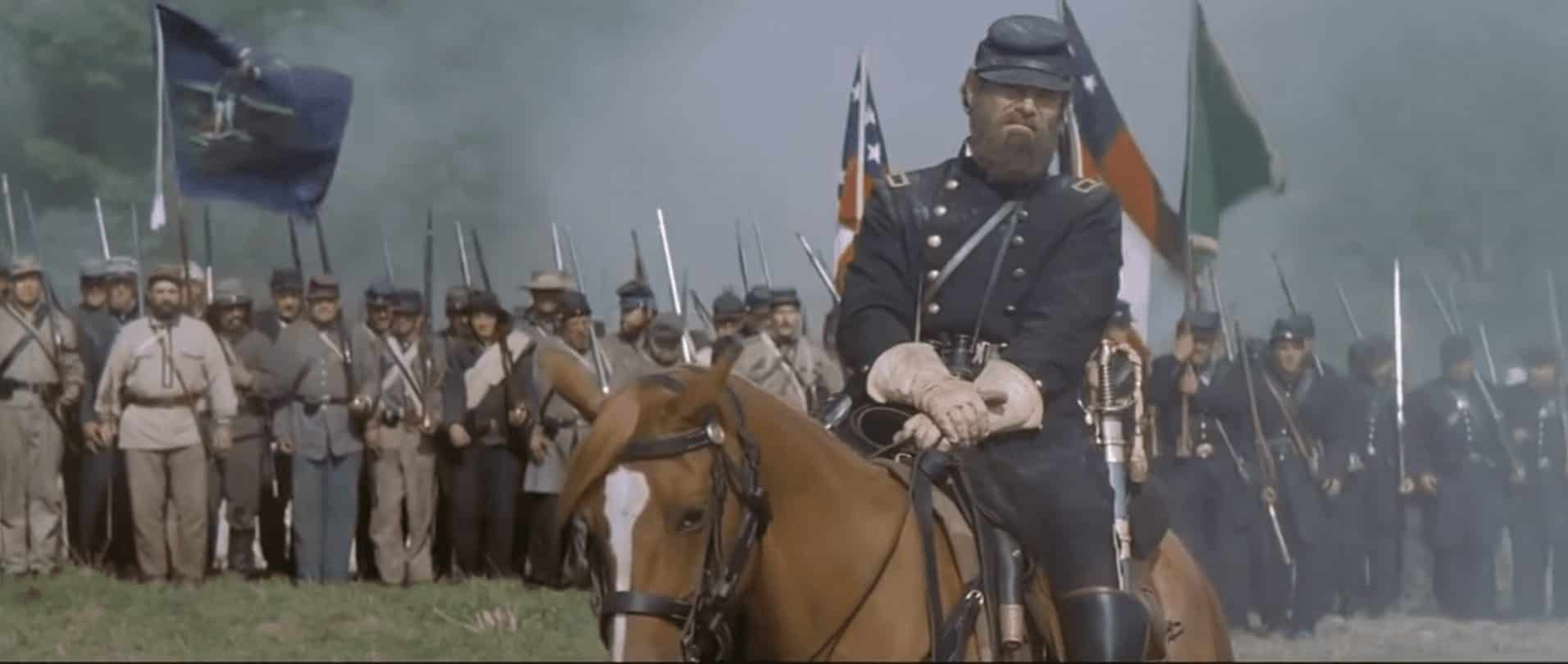
On Gods and Generals, a pretty big, Civil War film, we’re given certain information up front:
For background, we’re using reenactors who are providing their own uniforms. And, in many cases, Civilian reenactors provide necessary civil clothing. This is good news because we have about 168 cast member speaking parts. Many have multiple changes, as our story covers three years of time. And, most with several changes duplicated for stunt doubles.
The script reads something like this: soldiers, battle, battle, civilian crowd, battle, battle. With cast interspersed throughout. Our big problem after cast clothing is in keeping up with the stunt department and effects department damage sure to be done during the battle scenes and split-off second units.
And, even though this is a very ambitious project in terms of scale – we’re told that being an independent film, the overall budget is defiantly not major studio and more resembles an overlarge ‘Movie of the Week’ – we prepare accordingly.
Once production starts, a routine set in this lasts for the next five months of shooting. Day one, first the good news: 600 extras show up; 300 wearing Union blue and 300 wearing Confederate gray. So far so good. Then the bad news: the director wants all 600 wearing blue, then all 600 wearing gray. Quick math will tell that we now have an unexpected 300 blue and 300 gray uniforms to issue. Plus, we have to have additional crew to help issue and retrieve. And, we now have to double and triple the amounts of stock on hand because of overnight maintenance, enlarged crowds and disappearing items.
Some days, a thousand or more reenactor extras show up to work, and in many cases, at least half of that amount are dressed wrong for what we’re shooting and have to be re-dressed by wardrobe.
Some nights, after a long days work, production doesn’t want to antagonize the already tired extras by having them stand in line to turn in their uniforms. So, they release the extras directly to their tent camps in our uniforms. Some people turn the uniforms in, and some go home in our uniforms perhaps to return on another day weeks later – perhaps not.
Whatever the causes, we’re losing clothes daily – which necessitate enlarging our tailor shop, from what is initially set up as a cast alterations operation to a full-time production uniform factory, turning our hundreds of items weekly.
Schedule is another problem for us. We have three units shooting. At one point, we have a unit shooting days and another shooting nights. Sometimes they are in different states. This means detailed coordination nightly with transportation as to what truck is going where tomorrow.
At this point, wardrobe has a 5,000 square foot department for a tailor shop and fitting stock, offices, washers and dryers and fitting rooms. A 48-foot trailer for ‘Blue’ army, another 48-footer for ‘Gray’ army, another 48-footer for ‘Cast’, another 48-footer for ‘Civilians’, a 10-ton for second unit, another for Civilian shuttle, a laundry van and three mini-vans, and about 30 costumers and tailors.
On the Civilian side, for whatever reasons, some weeks become dedicated to civilian scenes. This means, day after day, different crowd scenes are shot. Civilian reenactors are not always available during the week, and we have to dress large crowds. The problem is that Saturday, we’re fitting for Monday. Monday, we have hundreds working, while we’re fitting 200 to 300 civilians for scenes upcoming during the week. When Monday’s extras wrap, we have to have the clothes cleaned and returned to stock for leap-frog fittings while other crowds are working. We have to have a self-contained system to rotate hundreds of costumes through from fitting stock, to preparation racks, to the set to work, back to the department for breakdown, to and from the cleaners, resized and returned to stock for fittings. This means more clothes and more department people to handle them.
In the end, it all gets done – and it all looks pretty good.
But I don’t think I ever went to sleep one night for five months knowing if we had enough clothes for the next day.
Richard La Motte, a 35-year veteran of the business, has worked on numerous movies, serving as Military Costume Technical Advisor (Last of the Mohicans, Pearl Harbor), Costume Designer (Gods and Generals, Crazy Horse, Tecumseh, Rambo III, Goonies, The Island of Doctor Moreau, The Wind and the Lion, Hounds of Hell), Production Designer, Costume Supervisor, and Property Master. He is the author of the book, “Costume Design 101,” published by MWP. Richard’s website is www.RichardLaMotte.com.
Featured in StudentFilmmakers Magazine, January 2009 Edition.
Sign Up for your own subscription to StudentFilmmakers Magazine.
- Click here to sign up for the Print Subscription.
- Click here to sign up for the Digital Subscription.
- Click here to sign up for the Bulk Subscription for Your School or Business.