
By Fred Ginsburg, CAS, Ph.D.
As I write this, the Spring 2018 semester has just ended; and many of my current or former students walked proudly down the aisles, diplomas in hand, at my university’s commencement ceremony. That made me want to reflect on what advice I might have for our incoming crop of aspiring filmmakers, newly enrolled and about to embark on a long and demanding academic journey toward a degree in Cinema, Television, or Multi-Media.
Choosing the Right College: Important Details to Check Out
Before you choose a college, there are a few important details to check out. Everyone assumes a production degree from a (well-publicized) film school will land you a Hollywood career. That is not necessarily true.
Graduate Success Unveiled: Evaluating Employment Opportunities
All of the “big” film schools publish recruiting brochures highlighting several recent grads who have done exceptionally well in the biz. They fail to mention the hundreds of recent grads who have not done quite so well (to put it mildly). Don’t be misled by the rare accomplishments of a few; find out how well the majority of graduates have been able to find relevant employment in the industry.
Access vs. Availability: Understanding Facilities and Equipment
Do not be awed at first glimpse by the size and scope of the facilities and equipment inventory. Yes, the “big” schools have a lot more cameras and edit bays than the smaller university programs. However, that does not always equate to students having easier access to them. Large departments generally DO have more toys; but they also have a very large student population that need to access them. So being able to “checkout” a professional production package or “book time” in the post production rooms may not be that easy! Do your homework and ask a lot of questions.
Crunching the Numbers: Comparing Tuition Rates and Gear Costs
Some of the smaller departments might not offer the gross quantity of equipment, but be ready to do some math and compare tuition rates (especially in-state) versus the cost of renting or purchasing your own gear or software. For example, a few of the more famous colleges here in California charge upwards of $67,000 per year tuition. In four years, that is $268k. Some of the state schools run under $7000 per year, or $28k. That is a difference of $240,000 over four years! How much would it cost you to rent a camera package a few times (with student discounts), and to purchase your own computer along with copies of a couple software packages, such as AVID Media Composer, Pro Tools, etc. (also available at discounted rates for students)? Yeah, with $240,000 to work with, I would definitely not feel like I was missing out on the fun toys that only SOME of the students get to play with at some film schools.
Decoding Degree Options: Unraveling Academic Paths
Ask about the degree options. Some colleges offer B.A. (Bachelor of Arts) or B.S. (Bachelor of Science) degrees; and some even offer B.F.A. (Bachelor of Fine Arts). The different degrees may have similar academic requirements, or may be more lenient in terms of the number of production courses you can apply toward the degree versus mandatory general education credits.
Practical Learning for Future Filmmakers: Focusing on Hands-On Skills
I realize, as an Adjunct “Professor” (technically I do not hold the academic rank of full-time, tenured Professor – even though I do have a PhD in my field), that I should not be cynical of general EDU courses and be more open minded towards developing “critical thinking” by taking a lot of liberal arts type stuff. That does make a lot of sense if you want to be a contestant on Jeopardy or teach high school. I have earned multiple degrees in Film Production, but I have also spent most of my life as a working filmmaker. I can tell you that in the real world, what you KNOW is a lot more important than what is on your transcript. An Emmy and being accepted as an active member into the Cinema Audio Society (the CAS after my name) has advanced my career far more than my doctorate (except in the teaching world).
Relevance Matters: Choosing Courses for Real-World Success
Try to learn as much as possible about the hands-on aspects of Film Production during your college years. No one out there really cares about your being able to write long term papers about “academic” subjects such as mathematical cinematic influences, ethical fish history, polar ice cap diversity, or the comparison of early Russian cinematic tripods versus volcanic lava flows.
Juggling Commitments: Balancing Shoots and Academic Obligations
Concentrate instead, as much as possible, on: storytelling, pre-production, production, and post production. Cinematography, sound, editing, producing, design, script writing. The stuff that makes you a well-rounded and technically proficient potential employee!
Navigating Attendance Policies: Communicating with Professors
When you do have to take courses outside of your major, think in terms of finding relevant subject matter. To Direct, you should take at least one acting course over in the Theatre Dept. Cinematographers, learn more about Photography and Photoshop. As an Editor, take some music appreciation classes. Computer Sciences…absolutely. You care going to be working on computers, so learn how to network, build, and repair them. Writers should go heavy with Psychology and Sociology in order to learn about personality and social traits.
The Mundane Yet Essential: Accounting and Legal Knowledge
Don’t forget the mundane subject areas, such as Accounting. I truly doubt that you will ever use Calculus and Trig as a filmmaker, but keeping track of your finances and business expenses is essential. Contract Law and Entertainment Law is obviously quite useful.
Pursuing a Relevant Education: Making Informed Choices
Look through the college course catalog, and find subjects that will tie into your future career plans. Sure, there are a lot of “easy” or “fun” courses that you could sign up for to fill up your class menu – but why waste a good opportunity to learn something that will actually help you out in life.
Time Management: A Crucial Aspect of Filmmaking
One more bit of advice that I tell my film students. Filmmaking requires a dedication of your time (and finances). When you begin working on larger student productions – you will often find that it is necessary to miss classes a few days in a row in order to accommodate shooting schedules.
Planning Ahead: Balancing Shoots and Academic Obligations
Although the instructors who teach production classes are generally very understanding, you may find that the professors who teach the standard “academic” courses are not so tolerant of absences and missed tests. Bring this situation up with them BEFORE you register for their classes, or at least during the first week of the semester so that you can drop/add if it comes down to that. You should also try to take as many General Ed. (or elective non-major) courses during your freshman and sophomore semesters, so that you have more time to devote to your advanced production classes during your junior and senior years.
Conclusion: Embrace the Journey and Pursue Your Passion
In conclusion, selecting the right film school is a crucial step toward realizing your goals and aspirations in filmmaking. Consider factors beyond reputation, such as employment outcomes, access to equipment, and tuition costs. Focus on developing practical skills, prioritizing hands-on learning, and choosing relevant courses that align with your career path. Manage your time effectively and communicate with professors about shoot schedules to strike a balance between shoots and academic obligations. Remember, film school is not just about earning a degree, but about immersing yourself in the art and craft of storytelling. Embrace the journey, seize every opportunity to learn and grow, and never stop pursuing your passion for cinema.
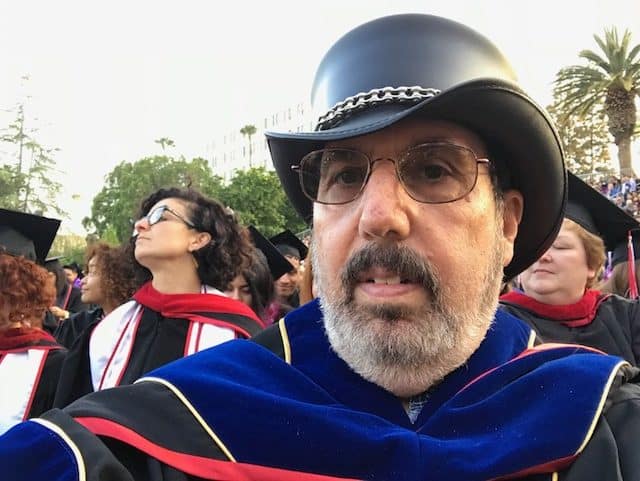
(Pictured: Fred Ginsburg, CAS, Ph.D.)