Backlighting for Video: Different Ways You Can Deploy a Back Light by Carl Filoreto

Reference: StudentFilmmakers Magazine

A lot of work I perform for clients hinges on the ability to create interview looks that are appealing to the eye. It’s true across the video production spectrum, from network news magazines to corporate image pieces. In the week prior to writing this article I received three calls from producers specifically looking for a DP who could deftly handle lighting high-end, high-production value interviews.

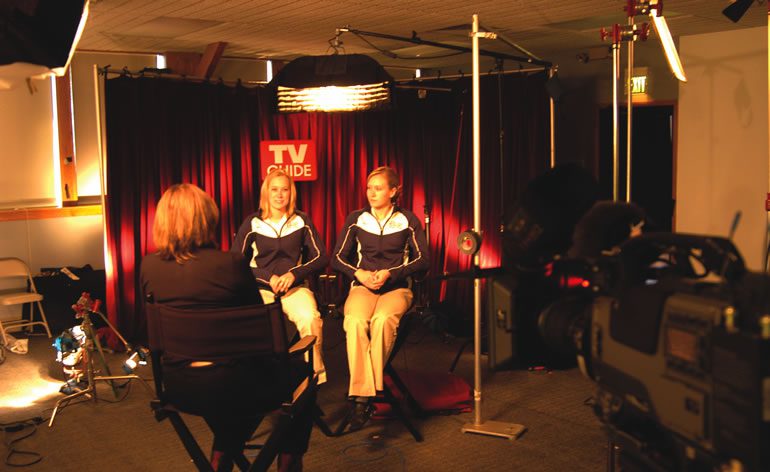
Well-lit, compelling-looking interviews can be seen in a lot of different places. Even reality shows using mostly handheld footage shot on the run often utilize well-composed interviews as the anchor of a video segment. When American Idol comes down the stretch run, the producers use carefully crafted interview locations to highlight their personality profiles. The well-crafted interview look, often using multi-camera set ups, has been a stylistic staple of Dateline NBC since its inception over a decade ago. And over the years I’ve worked with a producer who likes meticulously lit interviews where we place the camera on a jib or dolly and keep it in constant motion as a way to create a more dynamic look.

Interview set-ups can get fabulously complex, or they can be extremely basic. But you don’t necessarily need to back a two ton grip truck up to the loading dock to produce good lighting results. One of the basic ingredients in the recipe for good lighting is the simple use of a well-positioned back light. You can call it a kicker, a hair light or a shoulder light – whatever you’d like. Just always include it in your “must use” list. Even if I only have the time to set up two lights, one will of course be a key light, and the other will be a back light. It performs two vital visual chores: it provides separation between the subject and the background, and it also lends a sense of depth to the setting.
There are a number of different ways you can deploy a back light. One of the simplest and most efficient methods is to put a simple 100-200 watt fresnel on some type of boom arm, and then position it behind the subject. I usually put the light on a dimmer so I can easily adjust the intensity. For me, it’s easier to get the light in the position I like, then, control it from there.

Since I light most of my interviews using daylight balanced instruments, I put some ¼ or ½ color temperature blue (CTB) gel in front of the light. This helps match the color temperature of the fresnel to daylight, while still providing some additional warmth. Keep in mind, when you use a dimmer, you affect the color temperature of the light being emitted from the instrument. The more you crank it down, the warmer the light a tungsten instrument will give off. So you’ll probably want to compensate for the change. Otherwise, you may quickly move from a look that degenerates from one of pleasing warmth to one that has a disturbing reddish orange hue.

Staying with the basic theme, there are different ways to mount the light and get it in the most effective position. As I mentioned, you can take a simple beefy type stand, and put a straight boom arm on it. It doesn’t provide the most flexibility when positioning the light but it’s simple, quick and it works. Adding a clamp with a stud-like attachment will provide some maneuverability, while a handy device known in the trade as a magic finger will let you maneuver the light in a number of different directions, then lock it in place. Run the straight arm through a device formally called a mini grip head, or more commonly referred to as a “knuckle”, and you’ll achieve even more maneuverability. You can also use a combi stand, which has an articulating arm that folds out of the basic stand, and presto, it creates a dandy boom arm. It’s one stand with two distinct and effective uses. Also, remember that you’ll need some shot bags, usually of the fifteen pound variety, to throw on the base of the stand to anchor it and prevent if from tipping over. And you may need one to counter weight the boom arm. There’s not much worse than watching your stand begin leaning precariously during the middle of an interview, and threaten the safety of both the guest and any other innocent folks who are suddenly in harm’s way.

So let’s ramp it up here. Personally, I often like a back light to act as a hair light and to also throw a rim of light on the shoulders of the subject. That’s a lot to ask of a small fresnel. So I’ll reach into my bag of tricks and use a two bank fluorescent instrument. I can then be doubly clever and use one daylight and one tungsten lamp, which again throws that hint of warmth into the overall look. Unfortunately, most fluorescent based lights are rather heavy, so I have to set up a C-stand to handle the extra weight of the instrument. This is also a handy way to provide a backlight for multiple interview subjects. There are also light boxes that are much longer than they are wide, and with the help of a speed ring they’ll attach to most tungsten or HMI lighting instruments. They also make a dandy head and shoulder back light, or they can be used for a multiple subjects set up.

Okay, this discussion has been focusing on the mechanics of whipping up a back light in short order and zipping it into place. But what is the most effective position for it? Well, beauty truly is in the eye of the beholder. Lighting is highly individualistic, and one person’s lighting epiphany is another’s demise. One of the first questions I’ll ask when I begin to set up is “What does the person(s) we’re going to interview look like?” My choice of set ups will depend on their sex, hair color, complexion and height. If it’s a woman with luxuriant blonde hair, then I’m smiling because back lights make blonde hair radiant, and I’d have to be an idiot to screw up the look. If it’s a professorial gentleman with a receding hairline or a professional football player with a buzz cut, then I’m probably going to dismiss the idea of a back light altogether. I’ll try to aim it at their shoulders and squeeze down the barn doors, but inevitably, it will produce a nasty hot spot on their skull. Not good.

There’s a myriad of choices. Some DP’s like the back light to come from directly down the middle and over the top, while others like to slide the backlight so that it comes in more from the side. Since you’re working in three dimensions you also have vertical space choices. The lower the position of the backlight, the more prominent it will become. Raising the height of the backlight will produce a more toppy look, and it will also increase the range of the light, making it easier to hit the subject’s shoulders. It’s all a matter of personal aesthetic choices, or choices based on achieving an overall unifying look to your video project. And keep in mind that you’ll need to use a French flag, or some approximation of one, to eliminate any unwanted flares from creeping into your lens. In a pinch, when I’ve cleverly left mine tucked away in a camera bag in my car, I’ve used a piece of cardboard and taped it to the top of the lens. Crude, yes. Effective, yes. Impressive to the other people in the room, no, but it solves the problem.

If you have access to the fire power, then you can also use backlights outdoors. This can be problematic and often the ambient light level is so high that you’d need an HMI the size of a small truck to produce enough light to be effective as a back light. However, if it’s cloudy, or it’s closer to dawn or dusk than it is to noon, then you can use a back light in the great out-of-doors. I roughly figure that if I’m using a 400 watt HMI as a key light, then I’ll need a light of about half that intensity as a back light. It’s a crude calculation, but it gives you an idea of what you’ll need.
Finally, the principles of backlighting can also be used for product shots or general b-roll footage requiring close-ups of various objects, items or devices that are referred to in the segment. In this case, it’s usually referred to as a rim light, and it can provide an additional polished touch that will enhance your video project.

All photos by Carl Filoreto.
Carl Filoreto is an award-winning DP, and his company is Elk Run Productions, Inc. (www.elkruntv.com), which has a roster of clients that spans corporations, production houses, crewing agencies, and broadcast and cable networks, including Dateline NBC, The Food Network, and The Travel Channel. Prior to starting his business, Carl won seven regional Emmy awards, numerous national and regional National Press Photographers awards, and multiple awards from Colorado Ski Country and the National Snowsports Journalists Association while working at KMGH-TV in Denver, WTNH in New Haven and WGGB in Springfield, Massachusetts.

About Us

StudentFilmmakers.com is where creatives grow. Learn filmmaking, connect with industry pros, and access tools, contests, and inspiring educational resources.

Advertisers

Sign up for our Newsletter

Discover exclusive access to free webinars, hands-on workshops, and cutting-edge insights into emerging technologies and workflows. Sign up with the form above to stay ahead in the fast-evolving world of filmmaking.

Scroll to Top
×