Words of wisdom from Rodrigo Prieto, ASC, AMC, Richard Crudo, ASC, Paul Auster,…
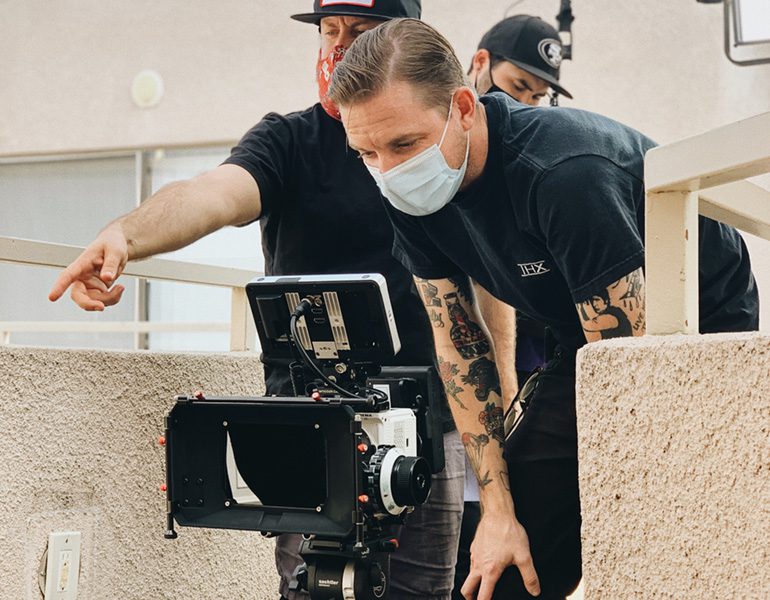
Pictured above: COVID Safe Filmmaking.
Photo by Chris Murray, Filmmaker and Photographer, Los Angeles, CA.
chrismurrayfilm.com | @SeeMurray
8 Directing Tips for New Directors
1. Direct with Passion
If I director does not have passion his focus and mental agility will not be at their best. A passionate director will submerge himself in the script and the production. He will inspire his team to new heights and help meet any obstacles or challenges.
“For me the most important thing is passion. And a director who is not passionate about his project can turn me off. That means sometimes I work with directors who will really challenge me and the crew, and we will work long hours, and it’s tough. But I much prefer that, to someone who just wants to get it done in a reasonable amount of time and go home, just get it in the can. So passion is the most important thing.” ~Rodrigo Prieto, ASC, AMC
2. Communicate
A director must be able to articulate the vision they see for the film and talk in terms that each individual working in their area of expertise can understand and share. Learn the terminology, watch movies so you can have something to compare your ideas with. If you like something in a movie you can tell your Cinematographer that you want the scene to be like such and such a movie. It’s not plagiarism. In this business, we all build on what others have done before us.
“The director must be a good communicator. If a person communicates and collaborates well, that’s a great start.” ~Richard Crudo, ASC
3. Be Committed
Making movies is highly competitive. Each director, cinematography, and actor wants to get the job and the accolades. Some of these people are ruthless and some are bitter and very difficult to deal with. Be strong and focus on the positive people and the love you have for the craft. Learn to navigate through the obstacles and focus on being your best.
“If you love to do it, just keep doing, and do the best work that you possibly can. It’s a very tough business, and it’s filled with very unsavory people. People you really don’t want to have to deal with that much. The work itself is such a joy. The spirit of camaraderie. The crew, the actors, all the technicians, the editors. All of these things are so enjoyable that I guess you just have to do the best work you can. All the time. And maintain the highest level possible.”
~Paul Auster
4. Research and Plan
If you want to be a great director you need to research and plan. Break down the scenes, the sets, and the shots and look for gaps in what your vision is. And ask questions.
“Find the questions and ask them—the simple ones, the obvious ones, but especially the ones that scare you.”
~Peter Markham
5. Safe Sets are Productive Sets
We have seen over the years accidents and deaths that did not need to happen if the crew had followed some basic safety guidelines. It might take a little more time to check the prop guns, special FX or even traffic and train schedules but it’s worth every minute. When a crew and cast know you put their safety first they are going to work better and put more of themselves in the production as opposed to feeling they are on an unsafe unprofessional set.
“Always run a safe set. Don’t ask anyone on the crew to take risks, always use common sense, and always follow the local / state laws and any regulations for the specific location. Make it your business to study the appropriate best practice guidelines and add a safety coordinator to your crew.”
~Mick Hurbis-Cherrier
6. Don’t Stop Shooting
Perfection can create an avoidance to move forward and thinking that you are going to wait for the perfect time, perfect script and perfect set could keep you from achieving your dreams. Make clips, even very short clips. It’s going to develop skills you will want to use along the way when you are directing features.
“Make a lot of movies. Short movies, clips, scenes, anything. Look at the Safdie brothers and how many countless short films – some even just a few seconds long – that they cranked out for years before jumping into a feature. Even if the actors are your roommates or family members, even if it’s shot and edited on your phone, and even (and especially) if it’s not a good film. Keep making them. Develop your eye by doing.”
~Greg Takoudes
7. It’s All About the Story
If you learn scriptwriting you are going to understand what actions are taking place and why they are in the script the way they are. Also, as anyone in the business will tell you, you have to have a good script to start. If the story does not give you that emotional response that it’s got what it takes then it probably doesn’t. And, even though good talented actors can make a bad script better a good script can be made great. Read some books on screenplays and write every day.
“Learn how to write a good script. It all starts on the page – you can’t make a good film from a bad script.”
~Todd Davis
8. Determination is 99% of Success
Once you see what it is you want to do start and don’t stop until it’s done. Make your plan and no matter what the obstacle find a way over it, under it, around it, or thru it. Don’t let so-called experts discourage you if you know you want to do it. How many times has someone said that directors, actors, or filmmakers didn’t have a chance that became some of the greatest filmmakers of all time? If someone tries to shut you down think about Lucille Ball and follow in her footsteps. A ‘know it all producer” said she had no talent and should not be in the entertainment business.
“Trust your vision, be persistent, and never give up.”
~Lynn Hershman-Leeson
Learn to make Movies. Sign up for the Student Filmmakers Magazine at https://www.studentfilmmakersstore.com